Reconciliation Accountant: Role, Duties, Skills, and Salary
October 9, 2026 · 10 min read · By Charles Ugo
invoice
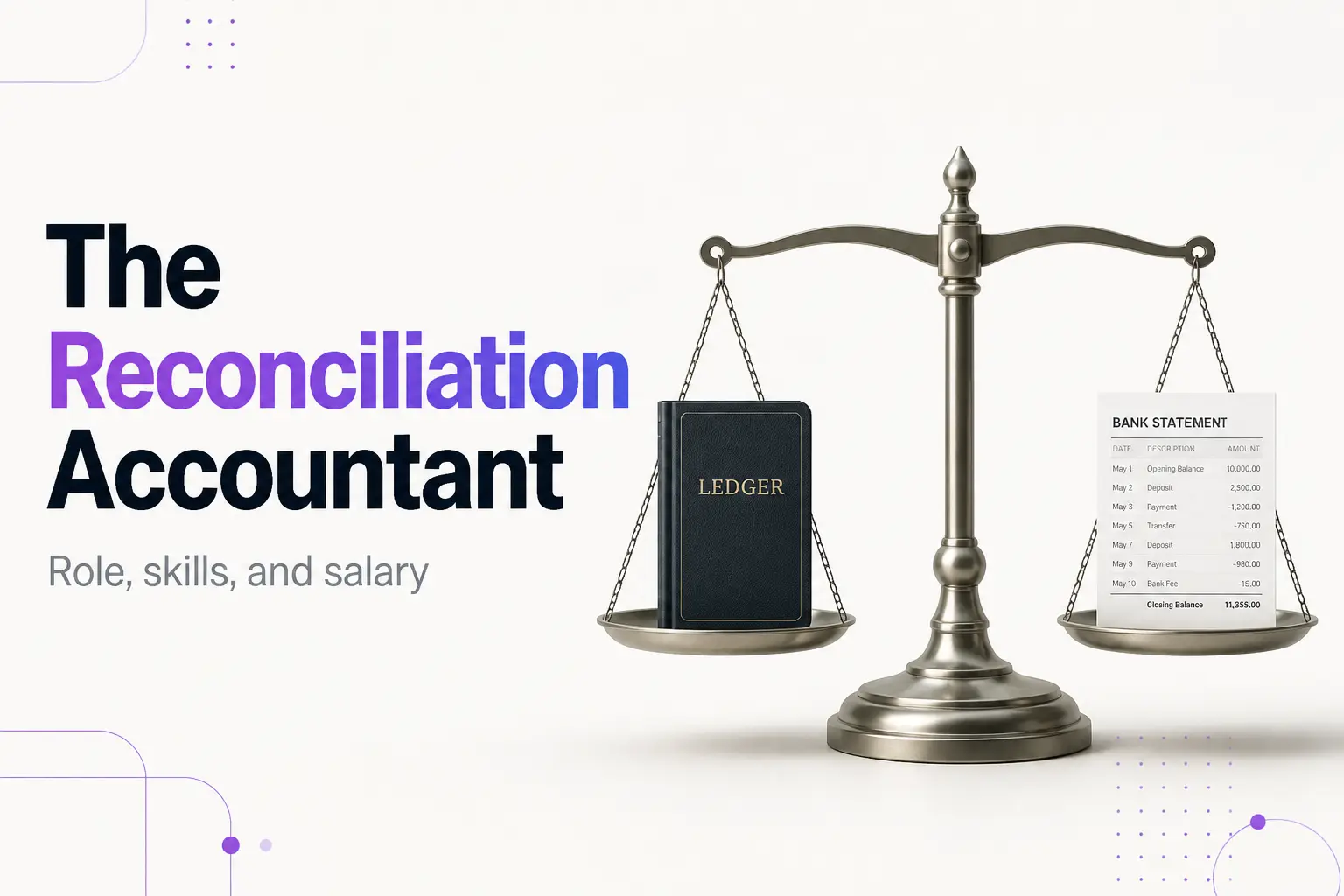
A reconciliation accountant is an accounting professional whose core job is to prove that a company's recorded balances match independent records — bank statements, credit card statements, vendor statements, and subledgers — and to investigate and correct every difference. They own the reconciliation part of the month-end close, produce the schedules that support the financial statements, and catch errors, missing entries, timing gaps, and the occasional sign of fraud before those problems reach a report.
Put simply: your books say one thing, the outside world says another, and the reconciliation accountant makes them agree — or explains exactly why they don't yet. This guide covers what the role does day to day, where it sits, the skills and certifications it takes, what it pays in the US, how it differs from a reconciliation analyst, and how to move into it.
Clean records make reconciliation faster, whichever side you're on. Our free invoice generator produces numbered, itemized invoices that are simple to match against payments at close — the first link in a chain a reconciliation accountant depends on.
What a Reconciliation Accountant Actually Does
The work is a comparison, repeated across many accounts. Account reconciliation is the process of comparing two sets of records to confirm the figures agree; a reconciliation accountant does this professionally, on a schedule, for the accounts that carry the most risk. If you want the mechanics of the process itself, our guides to account reconciliation and bank reconciliation walk through it step by step.
Typical day-to-day duties include:
- Reconciling balance sheet accounts — cash, credit cards, accounts receivable, accounts payable, prepaid expenses, accrued liabilities, and loans — each against its independent record.
- Matching the general ledger to subledgers. The general ledger balance for accounts receivable, for example, should equal the sum of open customer invoices; the accountant confirms it ties out and chases it down when it doesn't.
- Investigating variances. Every difference gets a reason: a bank fee never recorded, a duplicate entry, a payment posted to the wrong account, a deposit still in transit.
- Posting adjusting journal entries to correct the real errors, while leaving genuine timing items to clear on their own.
- Clearing aged open items — old unreconciled receivables and payables that have been sitting on a reconciliation for months.
- Building reconciliation reports and exception reports so managers and auditors can see what was reconciled, what was adjusted, and what's still open.
- Recommending process fixes when the same discrepancy keeps reappearing — a broken feed, a miscoded account, a control that isn't working.
Most of this clusters around the month-end close. High-volume cash and card accounts may be reconciled weekly or even daily, but the balance sheet reconciliations that support the financial statements land on a monthly cadence.
Where the Role Sits and Who Hires For It
The title appears most in organizations with enough transaction volume that reconciliation becomes a full-time job rather than one task among many: banks and other financial institutions, insurers, retailers and e-commerce companies, healthcare systems, and any business running a shared-services or corporate accounting center. In a small business, the owner or a single bookkeeper handles reconciliation as part of general bookkeeping; the dedicated "reconciliation accountant" title is a mid-size-and-up phenomenon.
The role usually reports into the accounting or finance department, often to an accounting manager or controller, and works closely with accounts payable, accounts receivable, and treasury.
Skills and Qualifications
Technical skills:
- Advanced Excel — pivot tables,
VLOOKUP/XLOOKUP,SUMIF, and the muscle memory to match two large lists fast. This is the single most-listed skill in job posts. - Double-entry bookkeeping and the accounting cycle — you can't reconcile an account you don't understand, and you have to know which side a correcting entry goes on.
- ERP / accounting systems — SAP, Oracle NetSuite, Microsoft Dynamics, or QuickBooks, depending on the employer. (Our guide to changing a QuickBooks invoice template is a small example of the kind of system fluency employers assume.)
- Reconciliation and close-management software — increasingly expected, especially on larger teams that automate the matching step.
Soft skills: attention to detail above all, plus clear written documentation (your reconciliation is someone else's audit trail), the ability to explain a variance to a non-accountant, and the organization to hit a monthly deadline without items slipping.
Education: most listings ask for a bachelor's degree in accounting or finance, and the Bureau of Labor Statistics notes a bachelor's degree is typically required for accountants and auditors generally. Some entry-level reconciliation roles accept an associate degree plus relevant experience, because demonstrated reconciliation work and spreadsheet skill can outweigh the exact credential.
Certifications: a CPA (Certified Public Accountant) or a CMA (Certified Management Accountant) is rarely mandatory for a pure reconciliation role, but either signals deeper knowledge and helps with pay and promotion into senior accountant, accounting manager, or controller positions.
What a Reconciliation Accountant Earns
Pay depends on experience, industry, and location, so treat any single number as a market estimate rather than a fixed rate. According to ZipRecruiter and Salary.com figures for the US, reconciliation-focused accounting roles average roughly $83,000 per year, with a typical band from about $68,000 at the 25th percentile to around $103,000 at the 75th, and top earners above $120,000.
For a broader anchor, the Bureau of Labor Statistics reported a median annual wage of $81,680 for accountants and auditors overall in May 2024, with employment projected to grow about 5% from 2024 to 2034 — faster than the average across all occupations. Reconciliation is a stable, in-demand corner of that field, because every organization with a balance sheet needs someone to prove the numbers.
| Level | Rough US annual range* |
|---|---|
| Entry-level / junior | $55,000 – $70,000 |
| Mid-level reconciliation accountant | $68,000 – $95,000 |
| Senior / lead | $95,000 – $120,000+ |
*Blended market estimate from ZipRecruiter and Salary.com data; actual pay varies by employer, city, and industry. Figures are general information, not a guarantee.
Reconciliation Accountant vs. Analyst vs. Specialist
These titles overlap heavily and many employers use them interchangeably. The rough distinction most teams draw:
- Reconciliation accountant — leans on formal accounting: owns general ledger accounts, posts journal entries, supports the close, and sits in the accounting/finance department.
- Reconciliation analyst — leans on high-volume matching, exception reporting, and the reconciliation software; often sits in operations or a shared-services team.
- Reconciliation specialist / clerk — usually a more junior, task-focused version handling the matching itself under supervision.
Don't over-index on the title when job hunting. Read the actual duties: whether the role expects you to post entries and own the accounting, or mainly to match transactions and report exceptions, tells you far more than the word before "accountant."
Worked Example: A Day in the Variance
It helps to see the job as a single case. Suppose the month-end general ledger shows a cash balance of $10,250, but the bank statement ends at $10,000 — a $250 gap the reconciliation accountant has to explain before the books can close.
They pull both records and tick off every transaction that appears on both sides. Two items are left unmatched:
GL cash balance                     $10,250
− Deposit in transit (recorded,
  bank hasn't posted yet)           already in GL
+ Outstanding check (recorded,
  not yet cashed)                   already in GL
Bank service fee (NOT in GL)        −  $250
The fix has two parts. The deposit in transit and the outstanding check are timing items — real, already recorded, just not posted by the bank yet — so they're left alone to clear next month. The $250 bank service fee, though, is a real charge the books never captured, so the accountant posts an adjusting entry (debit bank fees expense, credit cash) to bring the GL down to the true $10,000. The account now reconciles, the variance has a documented reason, and the reconciliation report shows exactly what changed and why.
Multiply that across a dozen accounts every month, and you have the job.
How to Become a Reconciliation Accountant
- Get the foundation. A bachelor's in accounting or finance is the common path; an associate degree plus bookkeeping experience can open entry-level doors.
- Get fluent in Excel and one accounting system. These two skills carry the most weight in early hiring. Practice matching large lists and building simple reconciliation schedules.
- Land reconciliation reps. Start as a bookkeeper, AP/AR clerk, or junior accountant and volunteer for the reconciliation work — bank recs, vendor statements, AR aging. That hands-on experience is what employers screen for.
- Add a certification when it pays off. A CPA or CMA isn't required but accelerates the move into senior and management roles.
- Learn a close-management tool. As teams automate matching, familiarity with reconciliation software separates you from candidates who only know spreadsheets.
Common Mistakes That Sink a Reconciliation
Whether you're doing the job or hiring for it, the same errors show up:
- Forcing a match. Plugging a number so the balances agree hides the exact error reconciliation exists to catch. Every difference needs a real reason.
- Ignoring aged open items. Old unreconciled entries don't disappear; they compound. Clear them while they're fresh.
- Reconciling only cash. AR, AP, credit cards, and prepaids are where quiet errors hide.
- Reusing invoice numbers. Duplicates are a classic source of reconciliation confusion — never reuse a number, even on a voided invoice.
- Skipping the documentation. A reconciliation nobody can follow later isn't an audit trail; it's a liability.
Where Clean Invoices Fit In
A reconciliation is only as fast as the records feeding it. On the accounts-receivable side, every invoice you send is a line the accountant will later match to a payment — so numbered, itemized, non-duplicated invoices make the whole close smoother. That's the same discipline whether you're a solo freelancer reconciling your own books or a corporate team closing a month.
Our free invoice generator and invoice templates produce clean, numbered, itemized invoices that reconcile cleanly against payments — so when someone ties the AR subledger back to the general ledger, the records already agree.
Frequently Asked Questions
What is a reconciliation accountant? An accounting professional who confirms that a company's book balances match independent records — bank statements, vendor statements, and subledgers — and investigates and corrects every difference. They own the reconciliation step of the month-end close.
What does a reconciliation accountant do day to day? Pulls GL balances, matches them line by line against outside statements, lists what doesn't agree, classifies each difference as a timing item or an error, posts adjusting entries for the corrections, clears aged items, and builds reconciliation reports.
How much does a reconciliation accountant make? US market data (ZipRecruiter, Salary.com) puts the average near $83,000, with a typical range of about $68,000 to $103,000 and top earners above $120,000. BLS reported a median of $81,680 for accountants and auditors overall in May 2024.
What skills do you need to be a reconciliation accountant? Advanced Excel, double-entry bookkeeping, comfort with an ERP or accounting system (SAP, NetSuite, QuickBooks), often reconciliation software, plus attention to detail and clear documentation.
What qualifications or degree does a reconciliation accountant need? Usually a bachelor's in accounting or finance; some entry-level roles accept an associate degree plus experience. A CPA or CMA isn't required but helps with pay and promotion.
What is the difference between a reconciliation accountant and a reconciliation analyst? The titles overlap. An accountant leans on formal accounting — journal entries, owning GL accounts, supporting the close — while an analyst leans on high-volume matching, exception reporting, and the reconciliation software. Read the duties, not the title.