Account Reconciliation: How It Works, Types, and Best Practices
September 7, 2026 · 11 min read · By Charles Ugo
invoice
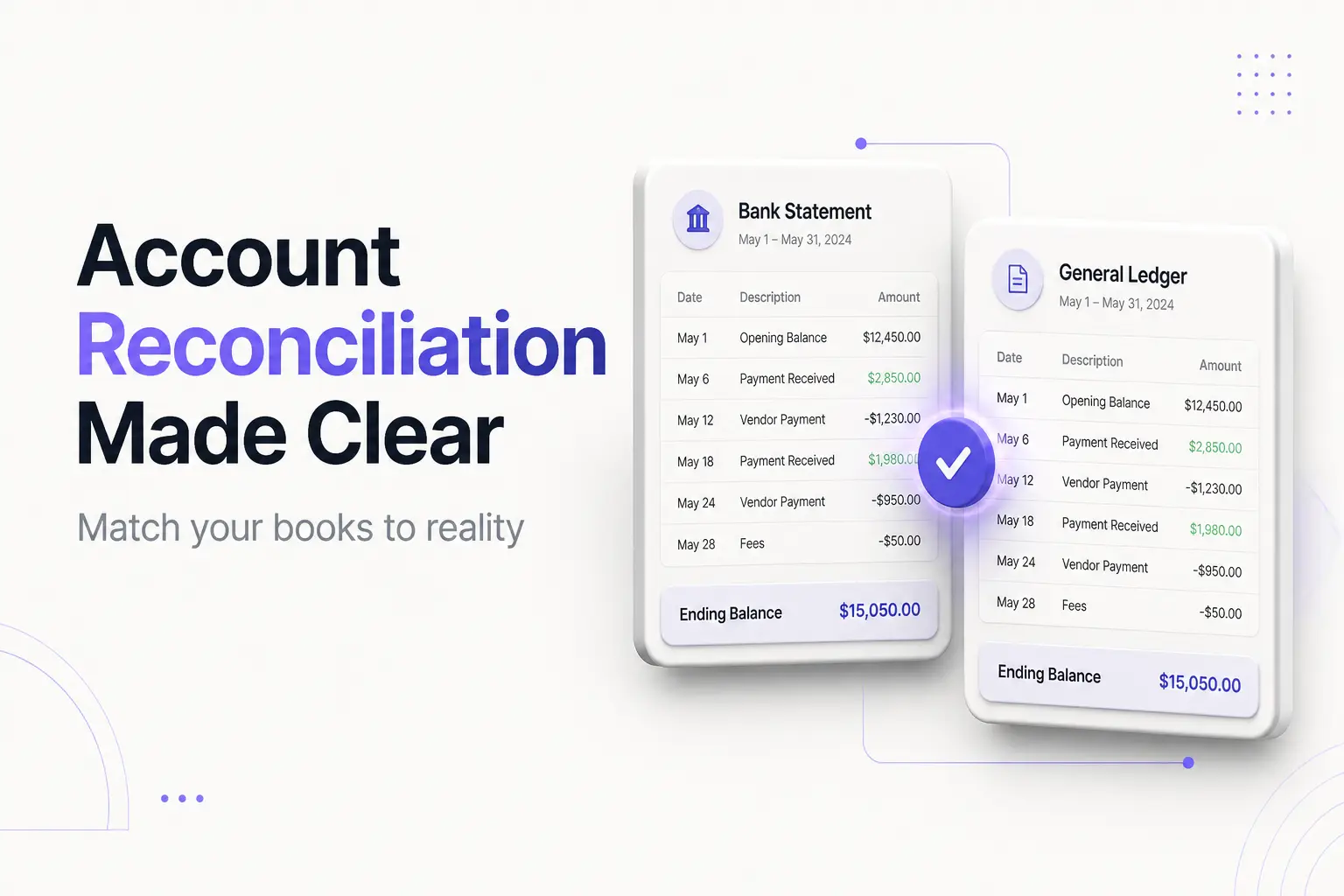
Account reconciliation is the process of comparing an account balance in your own books against an independent record — a bank statement, a credit card statement, a vendor statement, or a supporting schedule — and explaining every difference until the two agree. When they match, the account is reconciled and you can trust the number. When they don't, you've found an error, a missing entry, a timing gap, or something worse to chase down.
Think of it as a proof step. Your books are one version of the truth; the outside record is a second, independent version. Reconciliation lines them up and asks: do these tell the same story? If not, why not — and which one is right? This guide covers what account reconciliation means, the main types, the two review methods, the step-by-step process, two worked examples, and the mistakes that cause most reconciliation headaches.
Reconciliation starts with clean source documents. Our free invoice generator creates numbered, itemized invoices that are easy to match against payments later — the first step in keeping any account reconcilable.
What Account Reconciliation Actually Means
At its core, reconciliation is a comparison between two records of the same thing. Investopedia defines account reconciliation as the process of comparing two sets of records to check that figures are correct and in agreement, and confirming that money leaving an account matches the money actually spent. The word itself carries the idea: Merriam-Webster traces reconcile to the sense of making things consistent or compatible with one another.
The key point for beginners is the word independent. You are not checking your books against your books — you're checking them against a record kept by someone else: the bank, the card issuer, a supplier, or a subledger built from separate documents. That independence is what gives reconciliation its power. If both records agree, it's strong evidence the balance is real. If you only ever checked your books against themselves, an error copied into both places would never surface.
Why It Matters
Reconciliation is the routine that keeps your books honest. Done regularly, it catches:
- Errors — a payment entered twice, a decimal in the wrong place, a transaction posted to the wrong account.
- Missing transactions — a bank fee, interest, or a card charge you never recorded.
- Timing gaps — a deposit you've booked that the bank hasn't posted yet, so the two balances differ for a completely innocent reason.
- Fraud and unauthorized activity — a charge you didn't make, or money moving without a matching entry.
It also keeps you ready for tax time. The IRS expects businesses to keep records that support the income and deductions on your return, and reconciled accounts are the cleanest way to show your numbers hold together. (This is general information, not tax advice.)
The Main Types of Account Reconciliation
"Account reconciliation" is an umbrella. The mechanics are the same every time — compare your balance to an independent record, explain the gaps — but the independent record changes depending on which account you're reconciling.
| Type | Your record | Compared against |
|---|---|---|
| Bank reconciliation | Cash balance in your books | The bank statement |
| Credit card reconciliation | Card liability in your books | The card issuer's statement |
| General ledger reconciliation | A GL account balance | Its supporting subledger or schedule |
| Accounts receivable reconciliation | AR control account | The list of open customer invoices |
| Accounts payable / vendor reconciliation | What your books say you owe | The vendor's statement |
| Intercompany reconciliation | A balance with a related entity | The same balance on the other entity's books |
| Balance sheet reconciliation | Any balance sheet account | Its supporting detail |
A few of these are worth spelling out:
Bank reconciliation is the one most people meet first — matching the cash in your books to the bank statement and accounting for deposits in transit and uncashed checks. We cover it in depth in our guide to bank reconciliation.
Credit card reconciliation works the same way, with the card issuer's statement as the independent record instead of a bank statement.
General ledger reconciliation ties a general ledger balance to the detail behind it. The classic example: the accounts receivable total in your GL should equal the sum of every open customer invoice. If it doesn't, an invoice or payment was posted wrong. (For what AR is and why it's an asset, see accounts receivable meaning.)
Accounts payable / vendor reconciliation checks what your books say you owe a supplier against the supplier's own statement — catching a bill you missed or a payment they didn't apply.
Balance sheet reconciliation is the broad version of all of these: at month-end, you tie out every balance sheet account — cash, AR, AP, prepaid expenses, accrued liabilities, loans — to its support.
If your focus is specifically matching invoices to the payments that settled them, that's a close cousin covered in our billing reconciliation guide.
Two Ways to Reconcile: Documentation Review vs. Analytics Review
There are two accepted methods, and small businesses mostly use the first.
Documentation review is the hands-on approach: you compare your recorded balance line by line against source documents — the bank statement, invoices, receipts, loan statements, subledger reports — and verify each item. It's thorough and it's what most people picture when they think "reconciling the books."
Analytics review is the estimate-and-flag approach: based on past activity and normal trends, you work out roughly what a balance should be, then investigate anything that looks off — an unusual spike, a duplicate, an aging item that should have cleared. Larger finance teams use it to spot problems fast across many accounts before drilling in.
In practice they complement each other. Analytics review points you at what looks wrong; documentation review proves what actually happened.
The Account Reconciliation Process, Step by Step
Whatever account you're reconciling, the process is the same:
- Match the period. Pick a close date and make sure both records — your books and the independent source — cover the exact same span. A statement that ends on a different day than your book cutoff will never tie out.
- Gather both records. Your account balance from the books, and the independent record: statement, vendor statement, or subledger.
- Tick off what agrees. Go through and mark every transaction that appears on both sides with the same amount. Most items match — these are not the problem.
- List what's on only one side. Anything unmatched is either a timing difference (real, just not posted yet on one side) or an error/omission (needs fixing).
- Explain each difference. Deposit in transit? Uncashed check? A fee you didn't record? A duplicate? Assign every gap a reason.
- Adjust and correct. Post the entries your books were missing — fees, interest, charges — and fix any errors. Timing differences you leave alone; they'll clear next period.
- Confirm the balances agree, then document what you did — who reconciled, on what date, and what was adjusted. That record is your audit trail.
Worked Example 1: Reconciling a Checking Account
Your books show a checking balance of $10,250 at month-end. The bank statement ends at $10,000. They don't match — so you reconcile.
Ticking off transactions, you find two items on only one side:
- A $1,200 deposit in transit — a customer payment you received and recorded, but the bank hasn't posted yet.
- A $950 outstanding check — a check you wrote and recorded, but the recipient hasn't cashed.
Adjust the bank side for the timing gaps:
Bank statement balance            $10,000
+ Deposit in transit              + $1,200
− Outstanding check               −   $950
= Adjusted bank balance           $10,250
The adjusted bank balance ($10,250) equals your book balance ($10,250). The account reconciles, and both differences were innocent timing items — nothing to fix, they'll clear next month.
Worked Example 2: Reconciling a Credit Card Account
Now a case where you do need to fix your books. Your books show a business credit card liability of $3,200. The issuer's statement ends at $3,530 — a $330 gap.
You compare line by line and find two charges on the statement that never made it into your books:
- A $250 software subscription that posted late in the month.
- An $80 annual card fee.
Because these are real charges you simply hadn't recorded, you post them to your books:
Book card liability               $3,200
+ Software charge (unrecorded)    +  $250
+ Annual fee (unrecorded)         +   $80
= Adjusted book balance           $3,530
Now your books show $3,530, matching the statement. Unlike the timing items in Example 1, these needed correcting entries — the money really left, your records just hadn't caught up.
How Often to Reconcile
Reconcile most accounts at least monthly, right after the relevant statement closes, as part of your month-end close. High-volume cash and card accounts are often reconciled weekly or even daily, because the more transactions accumulate, the harder any single discrepancy is to trace.
The expensive mistake is waiting until tax season. A stale, unreconciled year is hours of untangling; twelve small monthly passes are almost painless by comparison.
Common Mistakes to Avoid
- Reconciling only the bank account. Cash is the easy one. AR, AP, credit cards, loans, and prepaid expenses need reconciling too — that's where quiet errors hide.
- Mismatched periods. Comparing a statement to a book balance cut on a different date guarantees a difference that isn't real.
- Ignoring timing items. Deposits in transit and uncashed checks are normal. Don't "fix" them — they clear on their own.
- Forcing a match. Plugging a number to make the balances agree hides the very error reconciliation exists to catch. Every difference needs a real reason.
- Skipping the correcting entries. Finding a missed fee and not posting it means the same gap reappears next month.
- Not documenting it. No record of who reconciled and what changed means no audit trail — and a close you can't repeat consistently.
Make Reconciliation Easier
Reconciliation is only as easy as your records are clean. A few habits do most of the work: reconcile on a fixed schedule so nothing piles up, keep every account's supporting documents in one place, and issue invoices that are numbered and itemized so each one matches cleanly to the payment that settled it — and never reuse an invoice number, even on a voided invoice, because duplicates are a classic source of reconciliation confusion.
That last part is where a good invoice starts the chain. Our free invoice generator and invoice templates produce clean, numbered, itemized invoices that are simple to match at month-end — so when you reconcile, the records already line up.
Frequently Asked Questions
What is account reconciliation? It's the process of comparing an account balance in your own books against an independent record — a bank statement, a credit card statement, a vendor statement, or a supporting schedule — and explaining every difference until the two agree. When they match, the account is reconciled; when they don't, you've found something to investigate.
What are the main types of account reconciliation? Bank, credit card, general ledger, accounts receivable, accounts payable/vendor, intercompany, and balance sheet reconciliation. The mechanics are identical each time — only the independent record you compare against changes.
What is the difference between account reconciliation and bank reconciliation? Bank reconciliation is one type of account reconciliation. Account reconciliation is the broad practice of checking any account against an independent record; bank reconciliation applies it specifically to cash and the bank statement.
What is general ledger reconciliation? Confirming that a general ledger balance matches its supporting detail — for example, that the AR total in the GL equals the sum of open customer invoices. If they don't tie out, a transaction was posted wrong, duplicated, or missed.
What are the two methods of account reconciliation? Documentation review compares your balance line by line against source documents. Analytics review estimates what a balance should be from past trends and flags anything unusual. Small businesses mostly use documentation review.
How often should you reconcile accounts? At least monthly, right after each statement closes, as part of month-end close. High-volume cash and card accounts are often reconciled weekly or daily. Waiting until tax time is the hardest and most expensive way to do it.