Billing address meaning: what it is and why it matters
August 23, 2026 · 8 min read · By Charles Ugo
invoice
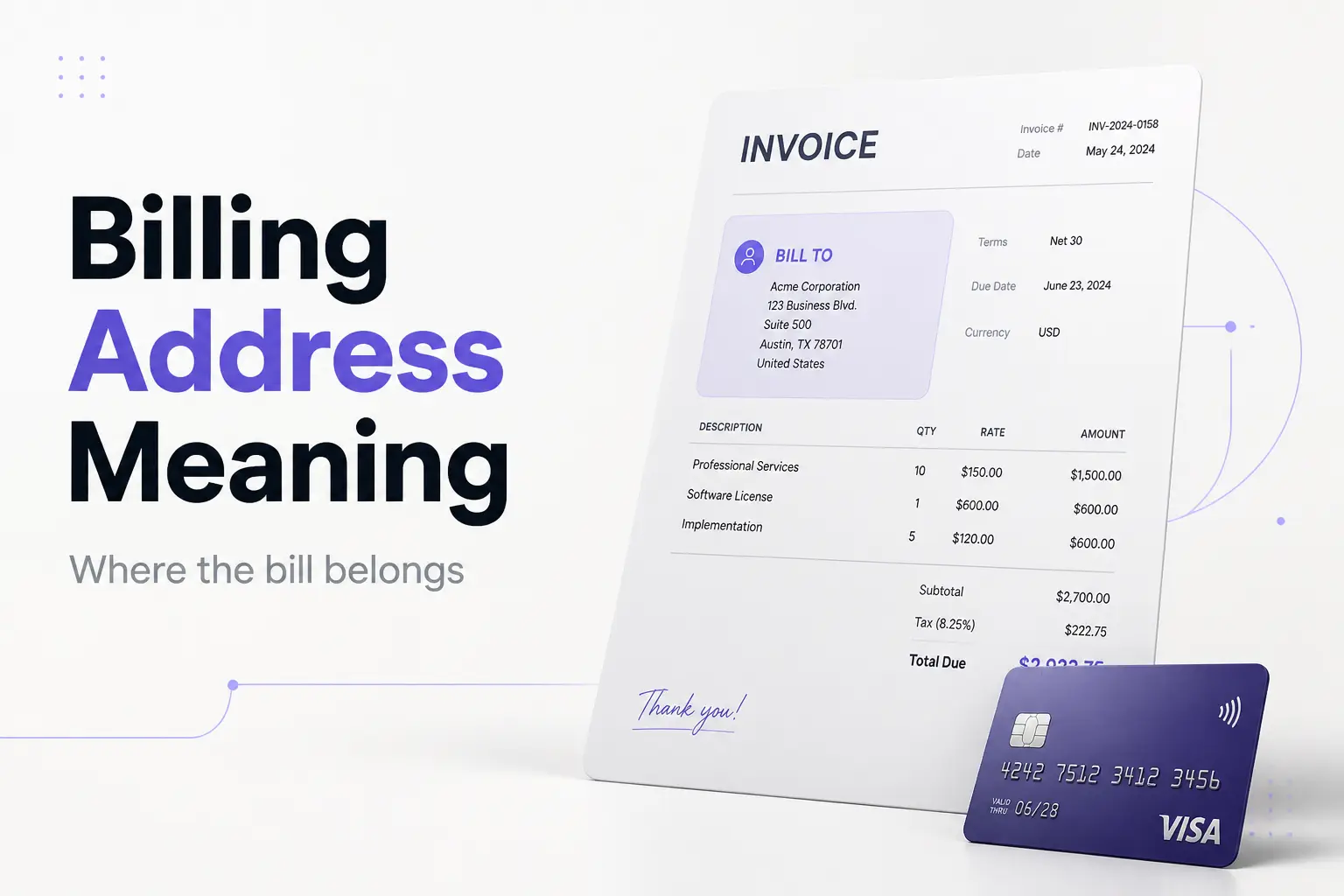
A billing address is the address linked to a payment method or an account — the address a bank, card issuer, or seller has on file for the person paying the bill. It is where statements are mailed and, at online checkout, the address that must match your card issuer's records before a payment is approved.
That is the short version. The word shows up in two slightly different places — on invoices and at card checkout — and the exact meaning shifts a little between them. This page covers both, plus how a billing address differs from a shipping address and what to actually type when a form asks for one.
Billing address in two everyday contexts
The phrase means the same core thing in both cases — the address of record for whoever is paying — but you'll meet it in two settings:
1. At checkout (card payments). Here your billing address is the address your bank or card issuer has on file for that specific card or account. Merchants ask for it to confirm you are the real cardholder. It is not about where the package goes; it is about verifying the payment.
2. On an invoice (the "Bill To" line). Here the billing address is the customer's address, printed in a block usually labeled Bill To. It tells the seller who owes the money, gives a legal record of the transaction, and is where a mailed statement or reminder would be sent.
The common thread: a billing address always belongs to the party responsible for paying — the cardholder or the customer — never to a delivery location or, on an invoice, to the seller.
What a billing address includes
A billing address is formatted like any standard US mailing address. It normally has:
- Full name (the cardholder's name, or the customer/company name)
- Street number and street name — e.g., 482 Maple Street
- A second line if needed — apartment, suite, unit, or floor
- City
- State (two-letter abbreviation, e.g., TX)
- ZIP code
For a business, the billing address may also carry a company name and sometimes a department or "Attn:" line so the bill reaches the right desk.
Worked example. Say Jordan Lee buys a monitor online with a personal credit card:
Jordan Lee
482 Maple Street, Apt 3B
Austin, TX 78704
That is the exact address Jordan's bank has on file for the card. If Jordan types anything different — an old apartment, a missing ZIP digit — the payment can be declined even with the correct card number.
Billing address vs shipping address
This is the distinction that trips people up most. They answer two different questions.
| Billing address | Shipping address | |
|---|---|---|
| What it's for | Verifying the payment | Delivering the goods |
| Whose address | The person paying (cardholder) | Wherever the item should arrive |
| Must it match records? | Yes — must match the card issuer's file | No — it's just a destination |
| Applies to | All purchases, physical or digital | Only physical shipments |
They are often identical — you buy something and ship it to your own home. But they split apart whenever the payer and the delivery point differ:
- Sending a gift: your billing address, the recipient's shipping address.
- Shipping to work: home billing address, office shipping address.
- Digital products: a billing address only — there's nothing to ship.
Most checkouts handle this with a "shipping address same as billing" checkbox. Untick it and you can enter each separately. For a deeper split of related terms, see our guide to invoice vs receipt.
The billing address on an invoice
On an invoice, the billing address lives in the Bill To block, and it belongs to the customer — the party who owes the money. It sits apart from the seller's own address, which appears in the header near the business name.
A simple layout:
FROM (seller)                 BILL TO (customer)
Riverbend Design Co.          Northlake Cafe LLC
19 Harbor Ave                 700 Center Road, Suite 2
Portland, OR 97201            Denver, CO 80202
The Bill To address does three jobs: it identifies who is responsible for payment, it creates a clear record of the transaction, and it's where a paper statement or reminder would be mailed. On a business invoice it may differ from the delivery point — a company might receive goods at a warehouse but want the invoice sent to its head office.
There is no federal rule in the US that dictates a single invoice format; the fields you include are practical, not a legal mandate. That said, keeping accurate address records on the invoices you issue and receive helps at tax time — the IRS advises keeping supporting business records such as invoices for as long as they may be needed. (This is general information, not tax advice.)
Building an invoice? Our free invoice generator gives you clearly labeled From and Bill To blocks so the billing address lands in the right place, and you can start from a ready-made Google Docs invoice template if you prefer to edit in a document. New to invoicing? Start with the beginner's guide to writing an invoice.
Why your billing address has to match
For card payments, the billing address is a fraud check, not a formality. Most online checkouts run it through an Address Verification Service (AVS), which compares the numeric parts of the address you enter — the street number and ZIP code — against what your card issuer has on file.
If they don't match, the transaction can be declined even when the card number, expiry, and security code are all correct. That's the system working as intended: it makes a stolen card number harder to use, because the thief also needs the cardholder's real address.
Two practical takeaways:
- Enter the address exactly as your bank has it. If you've moved recently, use the address the card is still registered to, then update it with your bank.
- A declined payment often means an address mismatch, not a bad card. Re-check the street number and ZIP first.
Common mistakes to avoid
- Confusing billing with shipping. Entering the delivery address in the billing field is the top cause of a failed AVS check when the two differ.
- Using an outdated address after a move. The billing address must match your bank's current record, not simply your newest home — update it with the issuer when you move.
- Putting the seller's address in "Bill To." On an invoice, Bill To is the customer. The seller's address goes in the header.
- Skipping the ZIP or a unit number. AVS keys on the ZIP and street number, so a dropped digit or missing apartment line can cause a decline.
- Mismatched records across accounts. If your invoicing tool, your bank, and your card all show different addresses, tidy them up so statements and payments don't go astray.
In short
A billing address is the address of record for whoever is paying — the cardholder at checkout, or the customer in an invoice's Bill To block. It exists to verify payment and to route the bill, which is why it must match your card issuer's file and why, on an invoice, it belongs to the buyer rather than the seller. It's separate from the shipping address, which only says where goods should go.
Ready to send one that's laid out correctly? Create a professional invoice in about two minutes with our free invoice generator, or see what a finished one looks like in what an invoice looks like.
Frequently Asked Questions
What is an example of a billing address?
A billing address looks exactly like a normal mailing address: a name, a street number and street name, an optional apartment or suite line, then city, state, and ZIP code — for example, Jordan Lee, 482 Maple Street, Apt 3B, Austin, TX 78704. The one rule that makes it a billing address is that it must match the address your bank or card issuer has on file for that payment method.
Is the billing address the same as the shipping address?
Not always. The billing address is tied to your payment method and must match your bank's records; the shipping address is simply where you want the goods delivered. They're often identical, but they differ any time you send a gift, ship to work, or pay with one household's card for delivery elsewhere. At checkout you can usually tick "shipping same as billing" or enter each separately.
Whose address is the billing address on an invoice?
The customer's. It goes in the Bill To block and tells the seller who owes the money and where to send the bill. The seller's own address appears separately in the header, so the Bill To address belongs to the buyer — not the person issuing the invoice.
Does the billing address have to match the card?
For card payments, yes. Most online checkouts run an AVS check that compares the billing address you type against your card issuer's records. If the street number or ZIP doesn't match, the payment can be declined even when the card number and expiry are correct. Update your address with your bank whenever you move.
What happens if my billing address is wrong?
At checkout, a wrong or outdated billing address usually causes a declined transaction because the AVS check fails. On an invoice, a wrong billing address is less likely to block anything but can delay payment, misroute a mailed statement, or cause bookkeeping errors — so confirm it before you send an invoice or submit a payment.