Invoice Factoring Companies: How They Work and How to Choose One
September 5, 2026 · 10 min read · By Charles Ugo
invoice
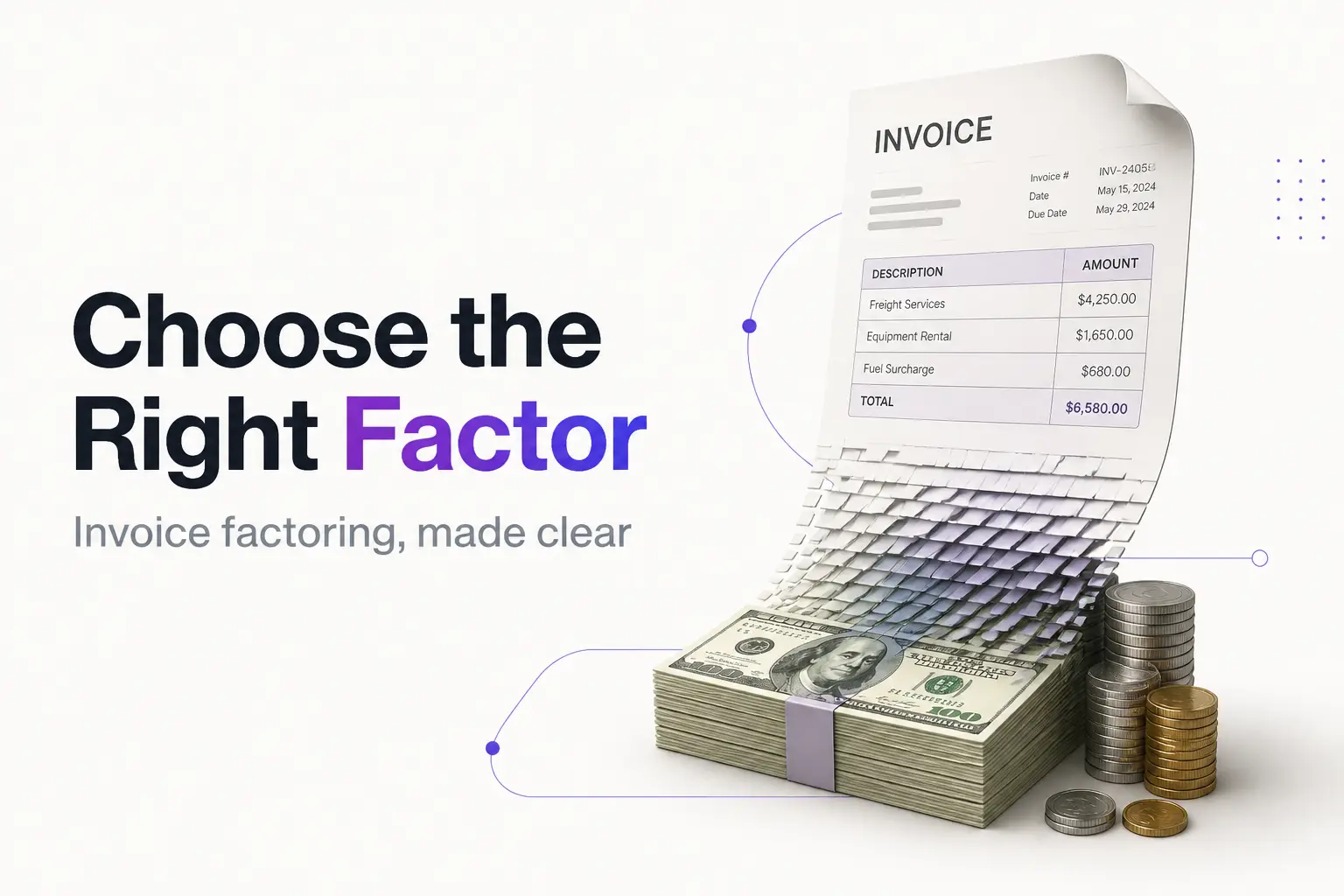
An invoice factoring company buys your unpaid invoices and pays you most of the money now instead of making you wait 30, 60, or 90 days for your customer to pay. You hand over a $10,000 invoice, get roughly $8,000 to $9,000 the same day or the next, and the factoring company collects the full amount from your customer later. When they collect, they send you the rest minus their fee.
That is the whole idea. The hard part is not understanding factoring; it is choosing a company that charges a fair rate, does not bury fees in the fine print, and does not lock you into a contract you regret. This guide covers how these companies actually work, what they cost, and the exact questions to ask before you sign.
If you only want the concept and the difference between factoring and discounting, start with our plain-English guide to invoice financing. This post is about picking a provider.
What an invoice factoring company actually does
A factoring company is a business that buys accounts receivable, your unpaid invoices, at a discount. Instead of lending you money, it purchases an asset you already own. That distinction matters, and we come back to it below.
Here is the flow, step by step:
- You do the work and invoice your customer. You send a normal invoice with normal terms, say Net 60. (New to terms like this? See what Net 30 means on an invoice — Net 60 works the same way, just 60 days.)
- You sell that invoice to the factoring company. You submit the invoice and any backup paperwork.
- They pay you an advance. This is a percentage of the invoice value, usually 80% to 95%, wired to you within 24 to 48 hours.
- They collect from your customer. In most factoring arrangements, your customer now pays the factoring company directly. The company handles the follow-up.
- They release the rest, minus the fee. Once your customer pays, you get the remaining balance (the "reserve") back, less the factoring fee.
A quick vocabulary check, because these three words decide your cost:
- Advance rate — the share you get upfront (e.g. 90%).
- Reserve — the share held back until your customer pays (e.g. 10%).
- Factoring fee (or discount rate) — what the company keeps for the service.
Because the factoring company gets paid when your customer pays, it cares most about whether your customer is creditworthy, not whether you are. That is why factoring is reachable for young businesses, ones with thin credit, or ones a bank already turned down.
A worked example: what it really costs
Say you run a staffing agency and invoice a large, reliable client for $20,000 on Net 60 terms.
- Advance rate: 90% → you receive $18,000 the next day.
- Reserve: 10% → $2,000 held back.
- Factoring fee: 2% per 30 days. Your client pays in 60 days, so the fee is 2% × 2 = 4% of $20,000 = $800.
When your client pays the full $20,000, the company keeps its $800 fee and releases the rest of the reserve. You end up with $19,200 total, and you got the bulk of it two months early.
Now compare two headline rates that look different but are not:
| Company | Headline rate | Client pays in | Total fee on $20,000 |
|---|---|---|---|
| A | 1.5% / 30 days | 60 days | $600 |
| B | 3% / 30 days | 30 days | $600 |
Same cost. The lesson: compare the total fee over your real payment cycle, not the sticker rate. A low monthly rate on invoices that take 90 days to pay can cost more than a higher rate on invoices that pay in 30.
Recourse vs non-recourse: who eats the loss
This is the single most misunderstood part of factoring, and it changes your price.
Recourse factoring means you stay on the hook if your customer never pays. If an invoice goes bad, you either buy it back or swap in another invoice of equal value. It is cheaper because the factoring company keeps almost no credit risk. Most factoring in the US is recourse.
Non-recourse factoring means the company absorbs the loss if your customer defaults for a covered reason. It costs more, typically 0.5% to 1.5% extra per month, and here is the catch most people miss: non-recourse usually only covers a customer's confirmed insolvency or bankruptcy, not a customer who simply pays late or disputes the work. NerdWallet's breakdown of recourse vs non-recourse factoring is a good, neutral explainer of where that line sits.
On $100,000 of invoices over a year, that 1% monthly gap is roughly $12,000 in extra fees. Do not pay for non-recourse unless you know exactly what it does and does not cover — read the definition of a covered default in the contract.
Is factoring a loan? (No — and why that helps you)
Factoring is a sale of an asset, not a loan. You are selling invoices you already own, so there is no interest rate, no loan on your balance sheet, and no debt payment. That is why:
- Approval leans on your customers' credit, not yours.
- Startups and businesses with weak or short credit histories can still qualify.
- It does not directly add debt the way a term loan or line of credit does.
If you want to compare factoring against actual debt products like a line of credit or an SBA-backed loan, the SBA's loan program overview is the neutral place to start.
One tax note, as general information and not tax advice: factoring fees are a cost of doing business, and ordinary, necessary business expenses are generally deductible — see the IRS guidance on deducting business expenses. Confirm your specifics with a qualified accountant.
Which businesses use factoring companies most
Factoring is most common where you deliver first and get paid on long terms:
- Trucking and freight — the biggest single market; drivers factor loads to cover fuel now.
- Staffing agencies — payroll is due weekly but clients pay on Net 30 to Net 60.
- Construction and trades — subcontractors wait on slow-paying general contractors.
- Manufacturing and wholesale — big orders, big gaps between shipping and payment.
- Consulting and business services — project work billed on long terms.
If your business gets paid on delivery, in cash, or by card, you do not need factoring. Factoring solves a specific problem: you have done the work, the money is owed, and you cannot wait for it.
How to choose an invoice factoring company
Once you know the mechanics, choosing well comes down to a short checklist. Get quotes from four or five companies so you know what a fair rate looks like for your industry and volume.
1. Total cost, not the headline rate. Ask for the full fee schedule in writing. Beyond the factoring rate, watch for: setup or due-diligence fees ($0 to $500+), per-invoice fees ($5 to $25), monthly minimums, wire and ACH fees, credit-check fees per customer, and early-termination penalties. Ancillary fees can push the effective cost well above the quoted rate.
2. Advance rate. Higher is usually better for cash flow, 85% to 95% is common. But a very high advance paired with a fat fee is not a win. Weigh both.
3. Recourse terms. Know whether you are signing recourse or non-recourse, and exactly what any non-recourse protection covers.
4. Industry fit. A company that already factors trucking, staffing, or construction understands your customers, your paperwork, and your payment cycles. That means faster approvals and fewer surprises.
5. Contract length and minimums. Prefer month-to-month or short terms. Be wary of two- or three-year lock-ins, monthly volume minimums you might not hit, and steep early-exit penalties.
6. Whole-ledger vs selective. Whole-ledger (or full-service) factoring requires you to factor all eligible invoices and usually earns the best rate. Spot or selective factoring lets you factor a single invoice or choose which ones — more flexible, often pricier. Pick the structure that matches how often you actually need cash.
7. Collections style. In most factoring, the company contacts your customers to collect. Ask how they do it. A rude or aggressive collector becomes your reputation problem.
Red flags to walk away from
- Vague fee answers. "It depends on the situation" instead of a written schedule is a warning sign. A company that won't put every fee in writing is hiding something.
- Long lock-in with big exit penalties. Two- or three-year contracts with steep early-termination fees trap you if the relationship sours.
- Fees to touch your own reserve. Some companies charge you to access money they are already holding for you. Push back.
- Pattern of the same complaints. Skim online reviews and industry forums. One bad review is noise; the same complaint over and over is a pattern.
- Pressure to sign today. Real factors are fine with you shopping around. Urgency is a sales tactic.
Before you factor: send invoices a factor will accept
Factoring companies verify invoices before they buy them, and messy or incomplete invoices slow down (or kill) your funding. Clean invoices with clear customer details, dates, terms, and line items get approved faster. You can create a clean, professional invoice free with our generator so your paperwork is never the thing holding up your cash.
It also helps to stay on top of collections yourself where you still handle them — our guides on outstanding invoices and how to ask for payment keep your receivables in the shape a factor wants to see.
The short version
An invoice factoring company turns unpaid invoices into cash today by buying them at a discount. It is a sale, not a loan, so it hinges on your customers' credit and does not pile on debt. Expect a fee of about 1% to 5% per 30 days, plus extras to watch for. The winning move when choosing one: get several quotes, compare total cost over your real payment cycle, insist on a written fee schedule, pick a company that knows your industry, and read the contract for minimums and lock-in before you sign.
This post is general information, not financial, tax, or legal advice. Fees, rates, and terms vary by company and change over time — always confirm current details directly with the provider and a qualified advisor.
Frequently Asked Questions
What is an invoice factoring company?
An invoice factoring company is a business that buys your unpaid invoices at a discount and pays you most of the value right away, usually 80% to 95%. It then collects payment from your customer directly and releases the rest to you, minus its fee.
How much do invoice factoring companies charge?
Most charge a factoring fee of about 1% to 5% of the invoice value per month, plus possible extras like setup fees, per-invoice fees, wire fees, and monthly minimums. Always ask for the full fee schedule in writing before signing.
Is invoice factoring a loan?
No. You are selling an asset you already own, your unpaid invoice, not borrowing money. There is no interest rate or loan on your balance sheet. That is why approval depends more on your customers' credit than on yours.
What is the difference between recourse and non-recourse factoring?
With recourse factoring you must buy back or replace an invoice if your customer never pays, so you keep the credit risk. With non-recourse factoring the company absorbs that specific loss, but it charges roughly 0.5% to 1.5% more per month and the protection has narrow conditions.
Can I factor just one invoice?
Sometimes. This is called spot or selective factoring and lets you factor a single invoice or pick which ones to sell. Many companies prefer whole-ledger factoring, where you factor all eligible invoices, and reserve their best rates for it.
How do I choose the best invoice factoring company?
Get quotes from four or five companies, compare total cost per invoice rather than the headline rate, pick one that knows your industry, and read the contract for the minimums, the term length, and the early-termination penalty before you sign.