How to find the invoice price of a car (and use it to negotiate)
June 11, 2026 · 7 min read · By Charles Ugo
invoice
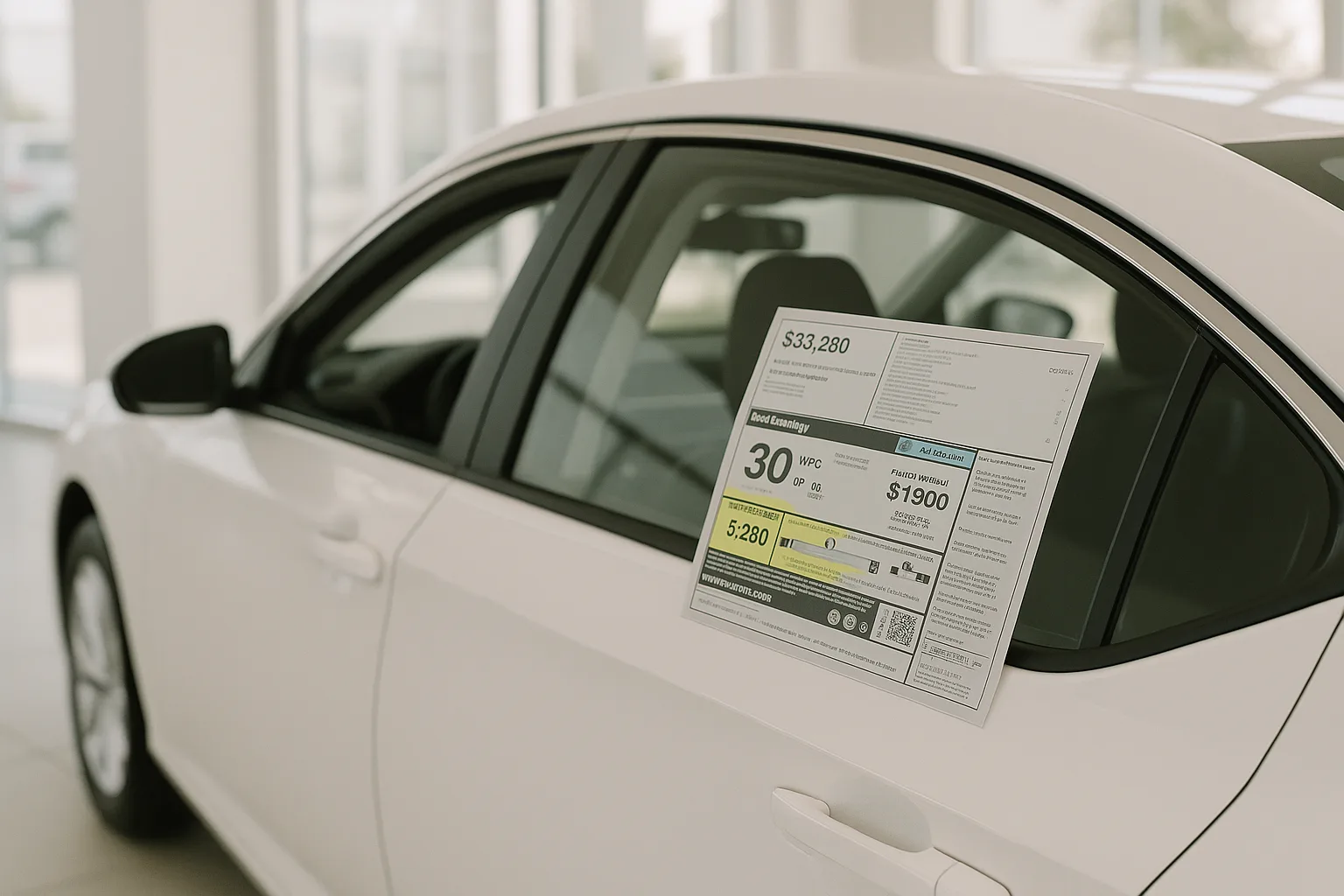
The dealer invoice price is the amount a manufacturer charges a dealership for a new vehicle. It is lower than the MSRP sticker price — and knowing it before you walk in gives you a concrete anchor for negotiation instead of guessing.
This guide covers what invoice price means, why it is not the dealer's true cost, how to find it for any specific vehicle, and how to use it when you sit down to talk numbers.
What "dealer invoice price" actually means
The invoice price is the line-item price on the manufacturer's bill to the dealer. It appears on official factory documentation (sometimes called the "manufacturer's invoice") and covers the base vehicle plus any factory-installed packages and a destination/delivery charge.
What it is not: Invoice price is not the dealer's true bottom-line cost. Two mechanisms reduce what the dealer actually pays after the fact:
- Holdback. Most manufacturers pay dealers a quarterly rebate — typically 2–3% of MSRP — simply for selling the vehicle. This amount is built into the system and does not appear anywhere visible to the buyer. According to Car and Driver's breakdown of invoice vs. sticker pricing, holdback can add up to several hundred dollars per vehicle.
- Manufacturer-to-dealer incentives. Separate from holdback, manufacturers push "dealer cash" or volume bonuses on slow-selling models or during promotional periods. These are negotiated between the manufacturer and the dealer and are rarely disclosed to buyers.
The practical takeaway: paying invoice price does not mean the dealer breaks even. They still pocket holdback and any incentive money they received.
Invoice price vs. MSRP vs. dealer cost vs. what you should pay
Understanding four numbers — not just one — gives you a complete picture of the deal.
| Term | What it is | Who sets it |
|---|---|---|
| MSRP (sticker price) | Manufacturer's Suggested Retail Price — the number on the window sticker | Manufacturer |
| Invoice price | What the manufacturer bills the dealer | Manufacturer |
| Dealer net cost | Invoice minus holdback and any dealer incentives — the true floor | Manufacturer (paid back to dealer) |
| Transaction price | What you actually pay | Negotiated |
Example: A compact SUV with a $38,000 MSRP might carry a $35,200 invoice. If the manufacturer's holdback is 2.5% of MSRP ($950) and the dealer is running a $500 regional incentive, the dealer's true net cost is roughly $33,750. That gap between $33,750 and $38,000 is the dealer's working room — and your negotiating window.
The "fair" transaction price lands somewhere between dealer net cost and MSRP depending on demand. In slow markets or at end-of-model-year sales, paying at or slightly below invoice is realistic. For in-demand vehicles with short supply, expect to pay closer to MSRP regardless.
How to find a car's invoice price
1. Use a pricing research site before you visit the dealership.
Kelley Blue Book (kbb.com), Edmunds (edmunds.com), and CarGurus publish invoice price data for new vehicles at no charge. Select the exact year, make, model, and trim — invoice prices vary by trim level and factory options, so being specific matters. These sites pull manufacturer invoice data directly, so their numbers are generally reliable.
2. Request the invoice from the dealer.
You can ask for the factory invoice in writing. A straightforward email works well:
"Hi, I'm interested in the [year] [make] [model] [trim]. Could you send me the factory invoice so I can review the line items before we meet?"
Many dealers will provide it, particularly if you signal that you are a serious and prepared buyer comparing multiple offers. Some states have disclosure requirements that make dealers more forthcoming — check your state's consumer protection rules.
3. Cross-check against multiple sources.
If two pricing sites show $35,200 and one shows $34,800, the spread is usually trim or options differences. Confirm the exact configuration you're pricing (including packages) is the same across every comparison.
4. Watch for add-ons not on the invoice.
Dealer-installed accessories — tinted windows, paint protection, nitrogen tires — often appear on a separate "addendum sticker" and are not part of the manufacturer invoice. These are frequently high-margin items and are nearly always negotiable.
How to use invoice price in a negotiation
The invoice price is most useful as an anchor, not as a demand. Here is how to deploy it effectively.
Start from invoice, not from MSRP. When you open the price conversation, reference the invoice: "I see the invoice on this trim is around $35,200. I'd like to start the discussion there." This reframes the negotiation around a documented number rather than the inflated sticker.
Account for market conditions. In a seller's market (limited inventory, high demand), dealers have no reason to discount deeply. In a buyer's market or near end of model year, invoice is a realistic target and below-invoice deals happen. Sites like MotorTrend's car research pages track days-on-lot data that signals how much pressure a dealer is under to move a specific model.
Get multiple offers in writing. Contact three or four dealers for the same vehicle configuration by email before visiting any of them. Once you have written offers, you can let each dealer know you are comparing — that alone typically produces lower numbers than walking in cold.
Negotiate the out-the-door price, not just the vehicle price. The final amount you pay includes fees, taxes, and any dealer add-ons. Agree on a total out-the-door figure and insist on a line-item breakdown. Vague "doc fees" and other dealer charges can add hundreds or thousands above the negotiated vehicle price.
Do not lead with your trade-in or financing. Dealers bundle these to obscure the true cost of each piece. Agree on the vehicle price first, then discuss trade-in and financing separately.
Common misconceptions about invoice pricing
"The invoice price is the dealer's cost." As covered above, holdback and incentives mean the dealer's true net cost is typically lower than the invoice. You are not asking for the impossible when you negotiate below invoice.
"Dealers never share the invoice." Most will, especially via email before a visit. Framing the request as routine due diligence — not as a challenge — makes dealers more cooperative.
"Paying at invoice is the best deal possible." On slow-selling models or at end of model year, below-invoice transactions are common. Invoice is a floor to negotiate from, not a ceiling.
"All fees on the invoice are fixed." Destination charges from the manufacturer are genuinely fixed. Dealer documentation fees, market adjustments, and accessory packages are negotiable or removable.
"You need to visit the dealership to get invoice data." Third-party pricing sites publish invoice data publicly. You can research before ever making contact with a dealer.
Frequently Asked Questions
Is the invoice price the dealer's actual cost?
No. The invoice price is what the manufacturer bills the dealer, but dealers also receive holdback payments (typically 2–3% of MSRP) and manufacturer-to-dealer incentives that reduce their true net cost below the invoice figure.
Where can I find a car's invoice price for free?
Kelley Blue Book (kbb.com), Edmunds (edmunds.com), and CarGurus all publish invoice price data for new vehicles at no charge. Enter the exact year, make, model, and trim to get accurate numbers.
Can I negotiate below invoice price?
Yes, in some situations. When a model has been sitting on the lot, demand is soft, or a model year is ending, dealers may accept below-invoice offers because holdback and incentive money still covers their profit.
Does the invoice price include destination charges?
Usually yes — destination and delivery fees are typically itemized on the invoice. Always ask for a line-by-line breakdown so you know exactly what you are looking at.
Does invoice price apply to used cars?
No. Invoice price is a new-car concept tied to manufacturer billing. For used vehicles, check Kelley Blue Book or CarGurus for fair-market value instead.